

You’ve probably heard it a thousand times: “Save your money.” It’s the first piece of financial advice most of us receive from parents, teachers, and well-meaning friends. And honestly? It’s not bad advice. Saving money is a responsible habit. But here’s the uncomfortable truth that most people don’t talk about: saving alone will not make you wealthy.
If you’ve ever done the math on a standard savings account, you know the returns are almost embarrassingly small. Meanwhile, inflation quietly chips away at the value of every dollar you set aside. You could spend decades disciplined enough to save diligently, only to find that your money hasn’t grown nearly enough to support a comfortable retirement or a financially free life.
We’ll break down exactly why investing is a far more powerful strategy for building long-term wealth than saving alone and how you can take practical steps to get started, no matter where you are right now. You might also want to explore symbols of wealth across cultures to understand the mindset that drives lasting financial success.
Why Investing Builds More Wealth Than Saving
Investing is a more powerful tool to build long-term wealth than saving because it gives your money the chance to compound and grow faster over time, while saving mainly protects your money from loss and keeps it easy to access.
Why it matters: Saving is best for emergencies and short-term goals. Investing is best for long-term goals like retirement, financial independence, and wealth building.
Simple comparison:
- Saving: low risk, low return, high access.
- Investing: higher risk, higher return, lower immediate access.
1. Understanding Saving vs. Investing
Before we dive deep, let’s get clear on what these two strategies actually mean because they’re often confused or treated as the same thing.
| Factor | Saving | Investing |
|---|---|---|
| Main purpose | Safety and short-term access | Long-term growth |
| Risk level | Low | Higher |
| Expected return | Lower | Higher over time |
| Best for | Emergencies and near-term goals | Retirement and wealth building |
| Inflation protection | Weak | Stronger over long periods |
What Is Saving?
Saving means setting aside a portion of your income in a safe, accessible place typically a bank savings account or money market account. The key characteristics of saving are:
- Low risk: Your money is safe. Banks are insured, and you won’t lose your principal.
- Low returns: Most savings accounts offer 0.5%-5% annual interest, depending on current rates.
- High liquidity: You can access your money quickly, which is great for emergencies.
Saving is ideal for short-term goals like building an emergency fund, saving for a vacation, or setting aside money for a down payment on a car.
What Is Investing?
Investing means putting your money into assets that have the potential to grow in value over time. These assets include stocks, bonds, real estate, mutual funds, ETFs (exchange-traded funds), and more. The key characteristics of investing are:
- Higher risk: Markets fluctuate. There’s always a possibility of losing money in the short term.
- Higher potential returns: Historically, the stock market has returned an average of 7–10% per year.
- Long-term focus: Investing rewards patience. The longer you stay invested, the more your wealth can grow.
The fundamental difference is this: saving protects your money, while investing grows it. Both serve different purposes and a smart financial plan uses both strategically.
2. The Power of Compounding
If there’s one financial concept that separates the wealthy from everyone else, it’s compound interest. Albert Einstein reportedly called it the “eighth wonder of the world” and for good reason.
How Does Compounding Work?
Compounding means earning returns not just on your original investment, but also on the returns you’ve already earned. In other words, your money makes money and then that money makes more money.
Think of it like a snowball rolling downhill. It starts small, but as it picks up more snow, it grows exponentially. Time is the hill, and your investment is the snowball.
A Simple Example: Saver vs. Investor
Let’s say two people Sarah and Mike both have $10,000 at age 25.
- Sarah puts her $10,000 in a savings account earning 2% annually.
- Mike invests his $10,000 in a diversified index fund earning 8% annually.
After 40 years (at age 65):
- Sarah’s savings: approximately $22,080
- Mike’s investment: approximately $217,245
Same starting amount. Same time period. The difference? The power of compounding at a higher return rate. Mike ends up with nearly 10 times more money than Sarah simply by choosing to invest rather than save.
3. The Impact of Inflation
Here’s a financial reality that many people overlook: inflation is silently destroying the value of your savings every single year.
What Is Inflation?
Inflation is the gradual increase in the prices of goods and services over time. When inflation rises at 3% per year, something that costs $100 today will cost $103 next year and $134 in ten years. Your purchasing power decreases unless your money grows at least as fast as inflation.
How Savings Fail to Keep Up
If your savings account earns 1-2% interest but inflation is running at 3-4%, you’re actually losing purchasing power every year even though your account balance is technically going up. You might look at your statement and feel good because you have more dollars. But those dollars buy less and less.
This is sometimes called the “savings trap”, the illusion of security while your real wealth quietly erodes.
How Investing Beats Inflation
Historically, a well-diversified investment portfolio, particularly one invested in the stock market has significantly outpaced inflation. While the market has ups and downs, the long-term average return of approximately 7–10% per year comfortably beats inflation, preserving and growing your real purchasing power over time.
Real estate investments, dividend-paying stocks, and index funds are particularly effective hedges against inflation over the long term.
4. Higher Return Potential
Savings Account Returns vs. Investment Returns
Let’s put the numbers side by side:
- High-yield savings account: 3–5% annually (and this is generous; many accounts offer far less)
- U.S. stock market (S&P 500): Average ~10% annually over the past century (roughly 7% after inflation)
- Real estate: Average 6–12% annually, depending on location and strategy
- REITs (Real Estate Investment Trusts): Average 8–12% annually
- Bonds: Average 3–5% annually (lower risk, lower reward)
These differences may seem small year to year, but over decades they represent life-changing amounts of money as the compounding example above demonstrates.
5. Long-Term Wealth Creation
The wealthiest individuals in the world from Warren Buffett to everyday millionaires next door share one common trait: they invested consistently over long periods of time. They didn’t try to time the market or get lucky on a hot stock tip. They invested steadily and let compounding do its work.
Financial Independence
Beyond retirement, investing is the engine behind financial independence, the point at which your investment income covers your living expenses and you no longer need to work for money. This concept (sometimes called “FIRE” Financial Independence, Retire Early) is achievable for ordinary people through disciplined, consistent investing over time.
Legacy Building
Investing also allows you to build generational wealth assets and resources that can be passed down to your children and grandchildren. Want to learn more about how to build wealth in your 20s? Starting early is one of the most powerful things you can do to secure long-term financial freedom.
6. Common Mistakes to Avoid
Even people who understand the importance of investing often make costly mistakes. Here are the most common ones and how to avoid them:
Mistake #1: Only Saving, Never Investing
Keeping all your money in savings feels safe, but it guarantees that inflation will erode your wealth over time. Comfort and safety are important but so is growth.
Mistake #2: Starting Too Late
Every year you delay investing is a year of compounding growth you’ll never get back. Many people say, “I’ll start when I have more money” and then they never quite find the right time. Start now, even if the amount is small.
Mistake #3: Ignoring Inflation
Not accounting for inflation when evaluating savings returns can give a false sense of security. Always ask: “Is my money growing faster than inflation?” If the answer is no, you’re falling behind.
Mistake #4: Panic Selling During Market Drops
The stock market will go down. It always has. Investors who panic and sell during crashes lock in their losses and miss the inevitable recovery. Staying the course during downturns is one of the most profitable decisions you can make.
Mistake #5: Not Diversifying
Putting all your money into a single stock or sector is a recipe for disaster. Diversification spreading investments across different asset types, industries, and geographies reduces risk and smooths out volatility over time.
7. Practical Tips for Beginner Investors
Ready to start? Here’s how to begin regardless of your experience level or income:
- Start small and start now: You don’t need thousands of dollars to begin. Many investment apps allow you to start with as little as $5–$50 per month. The habit matters more than the amount at first.
- Invest consistently (dollar-cost averaging): Invest a fixed amount every month, regardless of market conditions. This strategy called dollar-cost averaging reduces the impact of market volatility and removes the temptation to time the market.
- Diversify your portfolio: Don’t put all your eggs in one basket. A mix of stocks, bonds, and real estate (or REITs) helps balance risk and reward.
- Think long-term: Resist the urge to check your portfolio daily or react to short-term market news. Successful investing is a long game.
- Use simple, low-cost investment vehicles: Index funds and ETFs which track broad market indices like the S&P 500 are ideal for beginners. They’re diversified, low-cost, and have historically outperformed most actively managed funds.
- Take advantage of tax-advantaged accounts: Max out your 401(k) (especially if your employer offers matching contributions that’s free money!) and consider opening a Roth IRA for tax-free growth.
- Educate yourself continuously: The more you learn about personal finance and investing, the better decisions you’ll make. Books like ‘The Little Book of Common Sense Investing’ and ‘I Will Teach You to Be Rich’ are excellent starting points.
How Investment Returns Outpace Savings
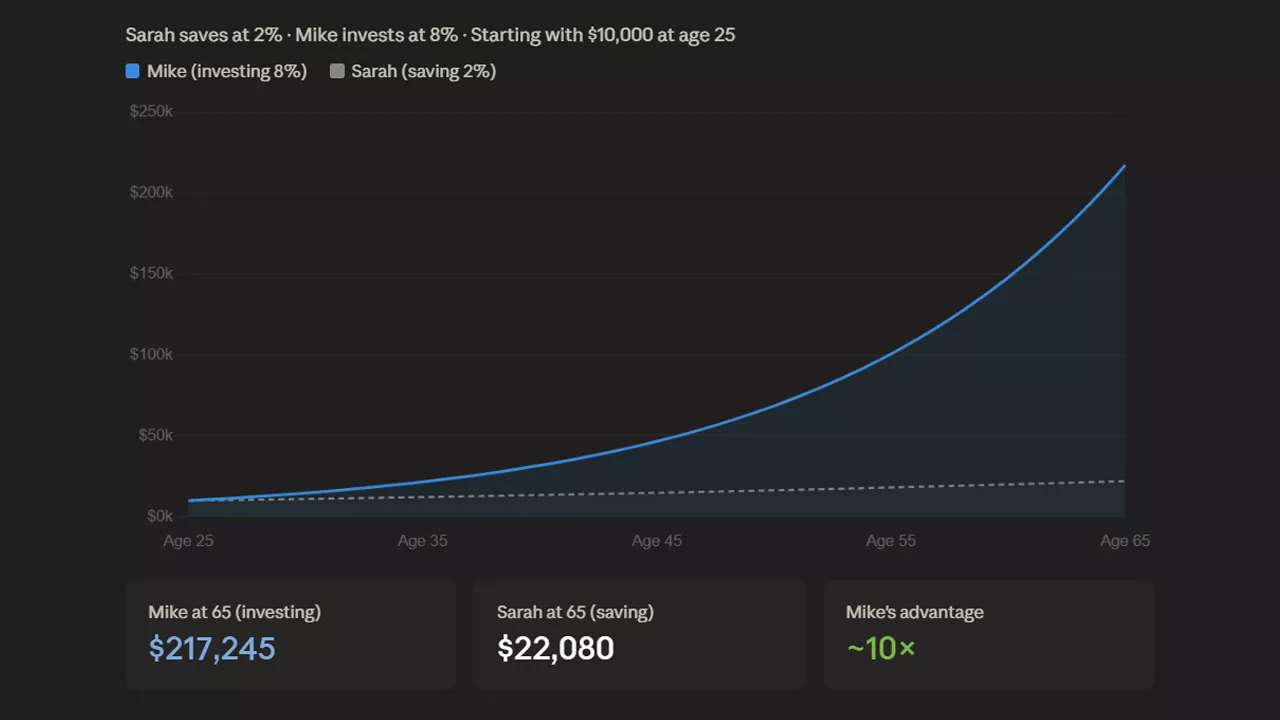
- Compounding power: the Sarah vs Mike illustration from the article: same $10,000 at age 25, but investing at 8% vs saving at 2% leads to nearly a 10× difference by age 65.
- Return rates: a comparison of typical annual returns across asset classes, from savings accounts to the S&P 500.
- Inflation trap: how the real (inflation-adjusted) purchasing power of your money changes over 20 years depending on what you do with it. Cash loses ~45% of real value; investing at 8% more than doubles it.
- Common mistakes: a clickable diagram of the five pitfalls the article warns against. Tap any node for a deeper explanation.
| Financial goal | Better choice | Why |
|---|---|---|
| Emergency fund | Saving | You need quick access and low risk. |
| Rent or bills next month | Saving | The money must stay liquid and safe. |
| Vacation in 6 months | Saving | Short time horizon means less room for market risk. |
| Car purchase in 1–2 years | Saving | You should avoid volatility for near-term spending. |
| House down payment in 3–5 years | Mixed, mostly saving | You may keep part in savings and part in low-risk investments. |
| Retirement | Investing | Long time horizon favors compounding and growth. |
| Children’s education in 10+ years | Investing | More time gives investments a better chance to grow. |
| Long-term wealth building | Investing | Growth potential is much higher over long periods. |
Conclusion
Here’s the bottom line: saving is important, but it’s not enough. In a world where inflation constantly erodes purchasing power and the cost of living keeps rising, saving alone will leave most people far short of their financial goals.
Investing particularly long-term, diversified investing harnesses the extraordinary power of compound growth and historically superior returns. It’s how ordinary people build extraordinary wealth over time. It’s how you fund a comfortable retirement, achieve financial independence, and leave a lasting legacy.
Saving protects your money. Investing grows it. You need both but if wealth is your destination, investing is the vehicle that gets you there.
The best time to start investing was yesterday. The second best time is today. Whether you’re 22 or 52, whether you have $50 or $5,000, you can take a step today that your future self will thank you for.
Frequently Asked Questions (FAQs)
Ideally, both. The recommended approach is to first build an emergency fund (3–6 months of expenses) in a savings account. Once that safety net is in place, direct any additional surplus income toward investments. Starting to invest early even small amounts is far better than waiting until you have more money.
Market corrections and crashes are a normal part of investing. They’ve happened many times throughout history, and the market has always recovered and gone on to reach new highs. If you’re investing for the long term (10+ years), a market crash is more of a buying opportunity than a catastrophe. The key is not to panic sell. Stay invested, keep contributing, and time will work in your favor.
A commonly cited guideline is to invest at least 15-20% of your income for retirement, though even 5–10% is a great start if that’s what you can manage. The most important thing is to start and be consistent. As your income grows, gradually increase your investment contributions.
For most people, especially beginners, yes. Research consistently shows that the vast majority of actively managed funds and individual stock pickers fail to beat the market over the long term. Low-cost index funds that track broad market indices like the S&P 500 offer built-in diversification, lower fees, and competitive long-term returns. They’re one of the best tools available to everyday investors.
Both are tax-advantaged retirement accounts, but they work differently. With a traditional IRA, contributions are made with pre-tax dollars (reducing your taxable income now), but withdrawals in retirement are taxed. With a Roth IRA, contributions are made with after-tax dollars, but qualified withdrawals in retirement are completely tax-free. For young people who expect to be in a higher tax bracket in retirement, the Roth IRA is often the preferred choice tax-free growth for decades is incredibly powerful.